
Este sitio utiliza cookies para ofrecerle un servicio más ágil y personalizado. Al utilizar este sitio, acepta el uso que hacemos de las cookies. Puede obtener más información sobre el uso que hacemos de las cookies y tecnologías similares y sobre sus opciones consultando nuestra Política de privacidad. Al hacer clic en "Acepto", acepta nuestro uso de cookies y tecnologías similares.
Cartel + Terrorism Liability
When Cartels Become
Terrorist Organizations,
Your Exposure Changes.
The May 2026 U.S. counterterrorism strategy has transformed how criminal risk is evaluated, prosecuted, and assigned to corporations. Companies with supply chains, operations, or commercial relationships in Latin America now face material support liability, narco-terrorism statutes, and SDGT sanctions exposure that existing compliance programs were never designed to address. Navigating this requires two things most firms cannot offer: the team that spent careers inside these investigations and the human intelligence networks that know the ground.
May 2026 Enforcement Signal: The White House counterterrorism strategy released May 6, 2026 expands cartel FTO designations into a sustained, escalating enforcement posture. Material support statutes, narco-terrorism liability under 21 U.S.C. § 960a, and SDGT sanctions now apply directly to multinational supply chain and commercial relationships. Companies with Latin America or Middle East exposure cannot rely on existing FCPA and AML controls alone.
Por qué Guidepost
The Difference Is the Experience That Walks Through the Door
Compliance firms can read the statutes. Law firms can cite the cases. What most cannot do is tell you what a cartel-controlled logistics corridor actually looks like on the ground, who the intermediaries are, and where the exposure hides. That knowledge comes from careers spent inside these investigations.
If your company has operations, supply chain relationships, or commercial dealings in Latin America or other high-risk regions, the time to assess your exposure is now, before an enforcement action, not in response to one. The Guidepost team brings the DEA expertise and LATAM human intelligence networks that this environment requires, and we are prepared to engage immediately.
Guidepost vs. The Alternatives
What This Specific Work Actually Requires
What the new enforcement environment requires is practitioners who have been inside these networks and investigators who can develop sources on the ground across Latin America. The difference is not a matter of effort or intention. It is a matter of what each type of firm is fundamentally built to do.
| CAPABILITY | GUIDEPOST SOLUTIONS | GENERAL CONSULTANT |
|---|---|---|
| Cartel network intelligence | ✓ Former DEA investigators with direct operational experience against Sinaloa, CJNG, and affiliated networks. They have built these cases from the inside. | Open-source research and commercial database screening. No practitioner-level familiarity with cartel organizational structures or how concealment is actually layered. |
| Latin America source development | ✓ Active human intelligence networks across Mexico, Colombia, Brazil, and Central America, cultivated through years of field investigation and cross-border law enforcement work. | Local affiliate relationships and desk review. Field intelligence depends on third-party referrals rather than established source networks with direct accountability. |
| FTO and terrorism liability expertise | ✓ Former federal prosecutors and DEA supervisors who understand what material support and narco-terrorism liability look like in a prosecution, not just in a statute. | Regulatory interpretation grounded in policy reading. Expertise is in the law as written, not in how enforcement authorities reconstruct corporate conduct under those statutes. |
| Supply chain field investigation | ✓ In-country investigators who reach beyond disclosed counterparties to the logistics providers, port operators, and security contractors that standard screening does not examine. | Questionnaire-based third-party review supplemented by database screening. Designed to assess what companies disclose, not to find what they have not. |
| Governance gap identification | ✓ Field-level interviews and source intelligence that surfaces how decisions are actually made in regional operations, independent of what headquarters policies say. | Document review and executive-level interviews. The gap between policy and ground-level practice is difficult to surface through standard assessment methodology. |
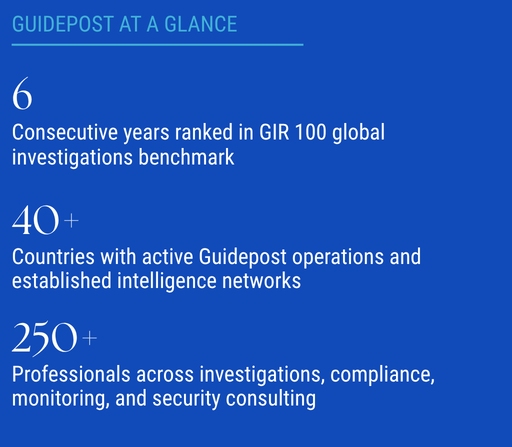
| Defensibility before enforcement authorities | ✓ GIR 100 ranked for six consecutive years. Findings are built by practitioners whom enforcement authorities recognize and are structured to withstand regulatory review and litigation. | Process documentation is strong. Investigative credibility within the specific enforcement community that now oversees cartel and terrorism-linked corporate risk is limited. |

Our Team of Experts
|
Presidente de Investigaciones Globales y Cumplimiento Normativo |
|
| Yohir Akerman Presidente, Región LATAM |
Andrés Otero Presidente, Región LATAM |
| Juan David Leal Managing Director, Mexico Office Head |
Melissa Price |

MSU Institutional Assessment + RAMAGELLAN MonitorshipEmpire/Liberty Review