



This site uses cookies to provide you with a more responsive and personalized service. By using this site you agree to our use of cookies. You can learn more about our use of cookies and similar technologies and your choices by reviewing our Privacy Policy. By clicking “I agree” you agree to our use of cookies and similar technologies.
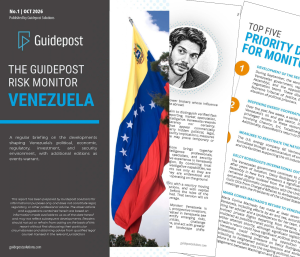
The Guidepost Risk Monitor: Venezuela
Issue I
A regular briefing on the developments shaping Venezuela’s political, economic, regulatory, investment, and security environment, with additional editions as events warrant.
This report has been prepared by Guidepost Solutions for informational purposes only and does not constitute legal, regulatory, or other professional advice. The observations and suggestions contained herein are based on information made available to us as of the date hereof and may not reflect subsequent developments. Readers should not act or refrain from acting on the basis of this report without first discussing their particular circumstances and obtaining advice from qualified legal counsel licensed in the relevant jurisdiction.
In this issue:
- Editor’s Note
- Top Five Priority Developments for Monitoring
- Strategic Outlook: Key Developments in Venezuela
- Analysis: Reopening Before It Is Rebuilding
Editor’s Note
Venezuela’s short-term outlook is increasingly shaped by the rapid expansion of oil and gas agreements and growing energy cooperation with the United States. The influx of investment from companies such as Chevron, Eni, TotalEnergies, Shell, GeoPark, Continental Resources, and potentially ExxonMobil reflects an accelerated reopening of the hydrocarbons sector. While political negotiations remain ongoing, energy developments continue to outpace institutional reforms, making further foreign participation in strategic sectors increasingly likely. At the same time, foreign companies are testing the boundaries of market reentry. Bilateral relationships are being recalibrated. And inside the country, the distance between official announcements and operational reality remains substantial.
The Guidepost Risk Monitor: Venezuela was created to make sense of that gap. This regular publication from Guidepost Solutions combines consequential news with intelligence from sources on the ground, with additional editions when developments warrant. Editions will also feature original analysis from a different Guidepost professional, reflecting that contributor’s expertise and experience. In this inaugural edition, “Reopening Before It Is Rebuilding” examines the implications of a commercial opening advancing faster than Venezuela’s political and institutional transformation. Our aim is to look beyond the headlines and identify what is changing, what is not, and what each development may mean for companies, investors, counsel, and decision-makers exposed to Venezuela.
Editions will track the issues that matter most: sanctions and enforcement; new investment and market entry; oil, gas, mining, and critical infrastructure; Venezuela’s evolving bilateral relationships, particularly with Washington and Bogotá; political and institutional dynamics; and the individuals shaping decisions behind the scenes. “Who’s Who” profiles will examine the officials, businesspeople, intermediaries, and emerging power brokers whose influence may not be visible abroad.
The Monitor will aim to distinguish verified fact from informed reporting, market speculation, and unresolved intelligence. Venezuela rewards neither complacency nor certainty. Developments that appear commercially promising may carry hidden political, legal, reputational, or security implications; measures that look definitive may prove temporary or unevenly applied.
Guidepost Solutions brings together investigators, intelligence professionals, attorneys, forensic specialists, and security experts with extensive experience in Venezuela and across the region. By combining local access with global investigative capabilities, we examine developments not only as they are reported, but as they are understood and experienced by those operating on the ground.
This first edition begins with a country moving faster than its institutions, and with capital considering a return before the rules of the road are fully established. That tension will sit at the center of our coverage.
The Guidepost Risk Monitor: Venezuela is designed to help clients, prospective investors, and other readers interested in Venezuela see around corners—to identify emerging risks, recognize opportunities, challenge conventional assumptions, and act with greater confidence before the landscape shifts beneath them.
Top Five Priority Developments for Monitoring
DEVELOPMENT OF THE SECOND PHASE OF POLITICAL NEGOTIATIONS
During September, the second round of political negotiations took place between the Venezuelan government, represented by Jorge Rodríguez (President of the National Assembly), and the opposition, led by Dinorah Figuera (head of the opposition negotiation team). These discussions addressed issues such as the renewal of the Supreme Tribunal of Justice, freedom of expression, the right to information, and the situation of political prisoners.
DEEPENING ENERGY COOPERATION WITH THE UNITED STATES
Over the past few weeks, a series of multi-billion-dollar agreements have been signed in Venezuela’s oil and gas sector, including the agreement granting the United States privileged access to these resources. This has been complemented by agreements involving Chevron, Eni, TotalEnergies, Shell, GeoPark, and Continental Resources. Additionally, ExxonMobil’s return to the country is anticipated.
MEASURES TO REACTIVATE THE NATIONAL POWER SYSTEM
The U.S. energy company GE Vernova was selected to participate in an initiative, formalized through a memorandum of understanding, to improve the national power grid and the facilities supporting the oil industry.
DELCY RODRÍGUEZ’S INTERNATIONAL OUTREACH
The Venezuelan government continues to prioritize restoring its international standing after years of isolation. Delcy Rodríguez’s participation in the United Nations General Assembly in New York represents a significant achievement for a government that has remained largely isolated from the international system. This is further reinforced by enhanced diplomatic cooperation with the United Kingdom, reflected in the promotion of Colin Dick from Chargé d’Affaires to Ambassador. This strategy has also included bilateral meetings with the Presidents of the United States and Paraguay.
MARÍA CORINA MACHADO TO RETURN TO VENEZUELA
María Corina Machado has made at least seven unsuccessful attempts to return to Venezuela, including efforts by air and sea, according to a September 23 Reuters report citing her adviser and a spokesperson for her team. Her most recent attempts reportedly involved private flights departing from Panama, with Aruba, Bonaire, and Curaçao considered as possible transit points. Sources familiar with her plans expect her to make another attempt shortly, although significant logistical and security obstacles remain. Machado’s return could have significant political and security implications. Her presence in Venezuela could reinvigorate the opposition and trigger large-scale public mobilizations, increasing pressure on Delcy Rodríguez’s government and potentially contributing to heightened political tensions and social unrest. Her return could also introduce a new variable into the ongoing political negotiations and the broader process of engagement between Washington and Caracas.
Strategic Outlook
Key Developments in Venezuela
Venezuela remains a fluid and complex environment. At the center of domestic and
international attention is a recent oil agreement granting North American Blue Energy Partners (NABEP) a 100-year concession to operate 17 oil fields with estimated reserves of 65 billion barrels and providing the United States with preferential access to a portion of the resulting production.
The participation of Venezuelan businessman Alejandro Betancourt, a director of NABEP, in this deal has drawn scrutiny in Washington. The Wall Street Journal reported on October 2 that a group of U.S. senators had questioned the agreement’s legality, transparency, and vetting, as well as whether it could undermine Washington’s stated support for a democratic transition. Separately, The Washington Post reported on August 27 that Betancourt had been the subject of money-laundering investigations in several jurisdictions, while noting that he has not been charged with a crime.
According to trusted sources familiar with the matter, the acceleration of economic agreements and the limited progress of negotiations aimed at facilitating a political transition from Delcy Rodríguez’s government suggest that the continuation of chavismo may be seen as the most effective way to ensure the implementation of recently concluded oil agreements. Nevertheless, the Trump administration may seek to revise the NABEP arrangement after the agreement generated what appeared to be a stronger negative public reaction than anticipated.
Accordingly, field analysis indicates that any new economic agreement, whether in the hydrocarbons, energy, or mining sectors, may not be well received by key actors within Venezuelan society. This is due to the events of January 3, when U.S. authorities captured Nicolás Maduro, which created genuine hope among Venezuelans for a real regime change that has yet to materialize. However, the opposition, despite its internal divisions, is not expected to oppose these developments, as its primary focus remains the negotiation process, which has now entered its second phase.
Foreign Companies Return
Despite these challenges, additional agreements in strategic sectors are likely to materialize in the near term, paving the way for the return of companies with the technical and financial capacity to contribute to the recovery of Venezuela’s oil industry. Recent weeks have witnessed a series of high-level agreements that are expected to strengthen both production and operational capabilities across the sector, helping to alleviate years of underinvestment and deterioration that had left key infrastructure in a critical state.
Consistent with this outlook, Chevron signed agreements contemplating approximately USD 7 billion in investment over the coming years, with the goal of significantly increasing its current production levels. In the European context, Eni reached an agreement to develop the Junín block in the Orinoco Oil Belt, which currently produces approximately 12,000 barrels per day and is projected to reach 200,000 barrels per day.
Likewise, the French company TotalEnergies signed an energy cooperation agreement with Venezuelan authorities to prepare the reactivation of its operations in Venezuela. This follows recent efforts by international companies seeking to participate in the reactivation of Venezuela’s oil and gas sector, including multinational firms Shell and GeoPark. Furthermore, local sources with access to the matter indicate that, in recent days, ExxonMobil has held several meetings with officials from the Rodríguez administration aimed at facilitating the company’s return to the country. According to these sources, the company’s initial objective is to regain control of Petrovictoria and Petromonagas.
Furthermore, Continental Resources and PDVSA recently reached an agreement that would allow the Oklahoma-based U.S. company to develop the Ayacucho 2 block in the Orinoco Oil Belt, where reserves are estimated at approximately 30 billion barrels.
Power, Mining, and Reconstruction
Additionally, following years of underinvestment in the country’s electrical infrastructure, the U.S. energy company GE Vernova was selected to sign a memorandum of understanding focused on improving the national power grid and facilities that support the oil industry. It is important to note that the prolonged deterioration of Venezuela’s electricity infrastructure has led to recurrent power outages across the country for years.
According to well-placed local sources, the Venezuelan government is increasingly focused on securing new understandings with Washington in the mining sector. Sources report that representatives from PDVSA and U.S. officials recently visited Tumeremo, in Bolívar State, in what is believed to be a preliminary step toward formalizing strategic mining agreements. In parallel, trusted contacts indicate that potential U.S. investment in La Guaira’s hospitality sector may also be explored in the coming weeks following the widespread damage caused by the twin earthquakes of June 24.
Diplomacy and Gold
Separately, Delcy Rodríguez’s government is pursuing a multipronged strategy to strengthen its international relationships. In this context, her participation in the United Nations General Assembly represents a significant achievement and is widely viewed as conferring a degree of international legitimacy not afforded to a Venezuelan president since at least 2018. Further reinforcing this trend is the recent decision by the United Kingdom to elevate its chargé d’affaires in Caracas to the rank of ambassador.
The United Kingdom remains a key stakeholder for Venezuela because approximately 31 metric tons of Venezuelan gold, valued at roughly USD 4 billion, remain held at the Bank of England following years of legal disputes over control of the assets. According to sources familiar with the negotiations, the Venezuelan government and opposition are nearing an agreement that could transfer the gold to the Federal Reserve Bank of New York. Under the proposed arrangement, Delcy Rodríguez’s government would gain legal control of the assets but would not be permitted to sell them immediately. Instead, the gold could potentially be used as collateral for government borrowing, including financing for reconstruction following the June earthquakes. Since 2019, the chavista government has pursued multiple legal avenues to gain access to these reserves without success.
Possible Election Timeline
Meanwhile, the second phase of political negotiations continued throughout September, led by Jorge Rodríguez on behalf of the government and Dinorah Figuera representing the opposition. According to available information, recent discussions at the negotiating table have focused on political guarantees, freedom of expression, and the right to information.
The renewal of the Supreme Tribunal of Justice (TSJ) would be prioritized within the framework of these talks, followed by a restructuring of the National Electoral Council (CNE). Successfully addressing these issues would represent a historic breakthrough and could pave the way for legislative elections during the first half of 2027, followed by presidential elections either in the second half of 2027 or at the beginning of 2028.
However, despite the major announcements that have been made regarding these negotiations, local sources remain cautious about the proposals, given that the chavista government has consistently demonstrated a lack of genuine intention to reach real agreements in the negotiation processes in which it has participated.
From a security standpoint, recent reports indicate that senior U.S. military and intelligence officials visited Venezuela to discuss potential operations targeting illicit groups in strategic regions such as the Colombian border and the Orinoco Min ing Arc. Combined with the Colombian government’s ongoing campaign against illicit economies, these developments point to a high probability of near-term operations aimed at reducing the capabilities of illegal armed groups, including the ELN and FARC dissident factions.
Analysis
By Yohir Akerman
President, Global Investigations & LATAM Region
Reopening Before It is Rebuilding
Venezuela’s commercial reopening is advancing faster than its political and institutional transition. Major energy and infrastructure commitments are taking shape, while additional investments in oil, mining, power generation, tourism, and reconstruction are under discussion. Yet the rules governing this new environment, and the durability of the arrangements being negotiated, remain unsettled.
That inversion matters. In most markets emerging from a prolonged crisis, political stabilization, institutional reform, and regulatory clarity create the conditions for capital to return. In Venezuela, capital may return first, driven by access to strategic resources, pressure to restore production, and a developing accommodation between Washington and Caracas.
The result is not a conventional transition, but a negotiation conducted through assets. Oil fields, mineral deposits, electrical infrastructure, frozen reserves, and access to international financing are becoming instruments through which political relationships are tested and power is redistributed. Commercial agreements are therefore doing more than allocating investment opportunities: they are helping determine who will control Venezuela’s economic reopening and who will emerge strengthened by it.
Our reporting suggests that this process could consolidate the current governing structure before it produces broader institutional change. New investment may improve production, generate revenue, and restore critical infrastructure without necessarily resolving the political questions that have shaped Venezuela’s crisis. Indeed, economic progress could reduce the immediate pressure for elections or deeper reform by giving those currently in power greater resources, international legi tim acy , and room to maneuver.
This creates a complicated risk landscape. The opportunities are real. Venezuela’s infrastructure needs are immense, its resource base remains strategically important, and early entrants may secure positions that become difficult to replicate later. But a commercial agreement can provide access to an asset without resolving questions about sanctions, ownership, political sponsorship, contractual enforceability, corruption exposure, physical security, or reputational risk.
The identity of the local partner or intermediary may be as consequential as the economics of the transaction. Equally important are the government entity authorizing the agreement, the political interests benefiting from it, and Washington’s stated or unstated expectations. An agreement that appears viable today could be revised tomorrow because of public opposition, competing interests within the government, a change in U.S. policy, or a future political settlement that challenges how the asset was awarded.
The domestic reaction is equally important. Parts of the opposition may view the reopening as evidence that economic normalization is being accepted without a democratic transition. Elements within chavismo may see the same agreements as an excessive concession of national resources to the United States and foreign companies. An arrangement supported by senior officials can therefore remain vulnerable from multiple directions, even while appearing politically protected.
For those assessing opportunities or existing exposure in Venezuela, navigating this environment requires more than conventional market analysis. It requires understanding the individuals behind a transaction, the interests connecting them, the provenance and control of the underlying assets, and the political and security conditions that may determine whether an agreement can actually be executed. By combining investigative due diligence, local intelligence, sanctions and integrity analysis, asset tracing, and security expertise, Guidepost Solutions can help clients test the assumptions behind an opportunity before capital, reputation, or personnel are placed at risk.
For companies and investors, the central question is no longer simply whether Venezuela is reopening. It is who is controlling that reopening, what political bargain sits behind each opportunity, and whether the resulting rights will survive any future political settlement. Venezuela may be open for business before it is ready for business. The difference between those two conditions is where the greatest opportunities and the most consequential risks will be found.
Get the Guidepost Risk Monitor
Subscribe to receive each monthly issue and special editions in your inbox.

MSU Institutional Assessment + RAMAGELLAN MonitorshipEmpire/Liberty Review